

 Blic
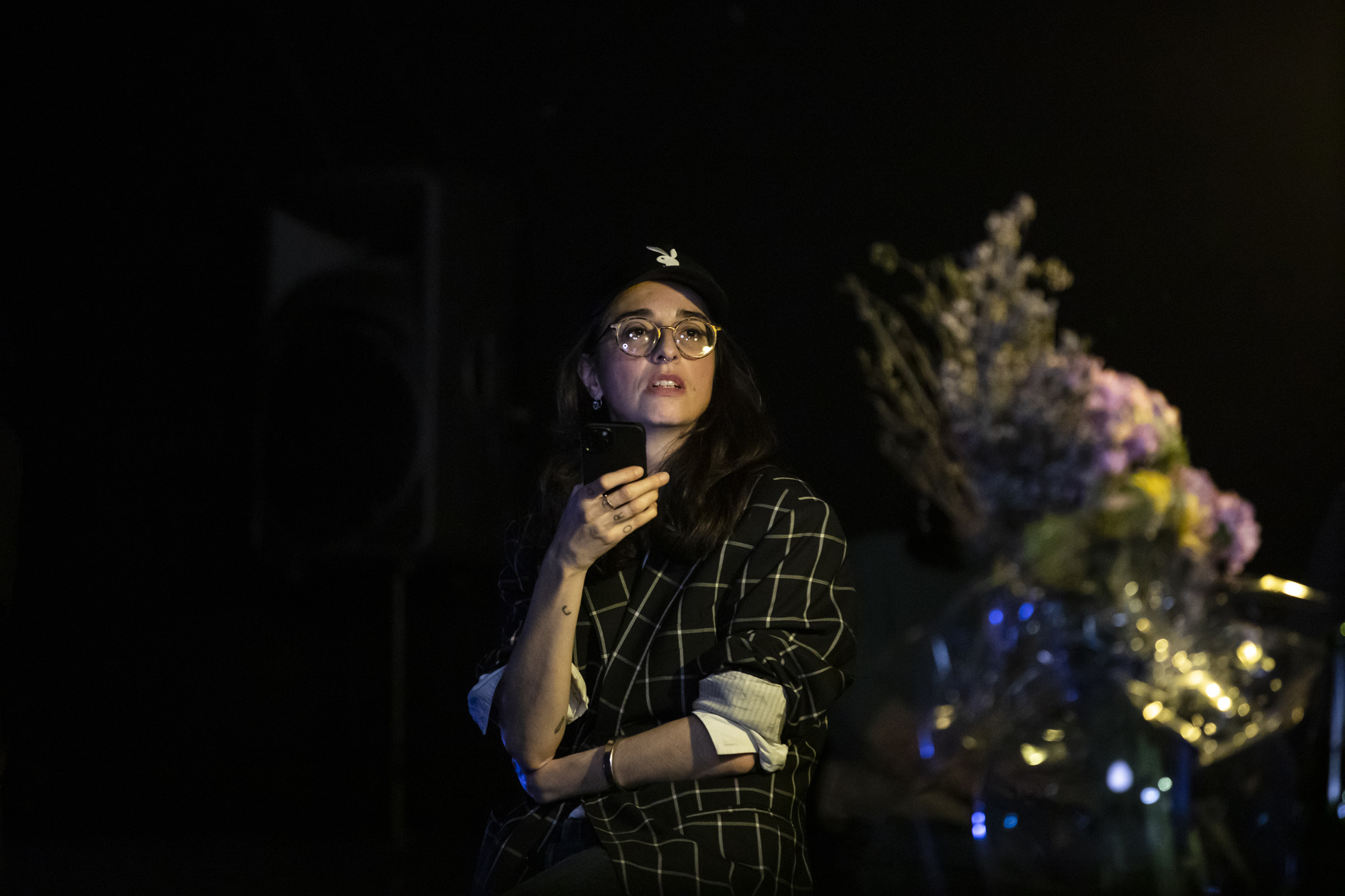
Blic Fette Sans has a conceptual and interdisciplinary practice that includes the production of images, writing, performances, online gestures, film-making, discussions, and installations. In 2024, she joined the Repair project, led by Kurziv (Kulturpunkt.hr’s publisher). In the framework of Repair, she developed a performance and video installation I passed the stage of disappointment long ago, presented in Pogon Jedinstvo as part of Exposium program.

Prior to the premiere, we seized the opportunity and talked to with Fette about unexpected biographical trajectories, incorporating spontaneous everyday interactions into artistic practice, and her recent move from Berlin to Zagreb.
When I first googled your name it said “Fette Sans a musical artist”. However, most of your work is in photography, text, performance and video. Can you tell us a bit about how you see yourself as an artist? Has your preference for a certain medium changed during the years and how do you see them intertwining?
It sounds amazing! I’m very interested in the mess of narratives and biographies.
The first medium where I felt comfortable doing something was photography. I learned it from my dad, who gave me his camera and I really enjoyed how this could be played with; you use this mechanical object which you need to imbue with a sort of magic. It’s in this moment, within this collaboration between the mechanical and the intangible that something will take place, an image will be made, and hopefully, this image will be something else than what you saw.
I became more concerned with the fact that, regardless of this concrete object and a certain pragmatic story of your now – this assumption that this moment exists, that doesn’t necessarily render the resulting images any real, or true. The surrounding narratives and this idea of an image residue became more interesting to me than the images themselves. Progressively I went away from the strict medium of photography and started doing things more with film, performances, installations – mediums that all discuss and play with images within the context of the hypermediated world we’re living in.
The fact that our experience is so unreliable is beautiful to me, so I think that became the central idea. The medium I feel like I’m working with the most is memory.
Currently, you’re developing a new project that will be presented in Pogon and other than the two presentations at Organ Vida there hasn’t been much of your work publicly displayed even though you’ve been living in Croatia for a while. Can you tell me a bit more about your life in Zagreb? How did you come to live here?
Yes, I’ve been here for a year and a half now. I was living in Berlin for the past ten years and I had been angsty to leave Germany for a while. COVID took a heavy toll on me for a lot of reasons and eventually, it hit me that I did not want to die in Berlin.
Where one comes from and where one is able to go is so deeply affected by national and economic privilege. I roam in a sort of economical margin and I have to make work within that. I first came to Zagreb at the invitation of Organ Vida, and then, I met someone I felt close to. That was definitely an impetus for me to move.
Since I have relocated here, there have been a lot of very generous things. Like the possibility to really host people, this is new to me. I never had a place truly of my own, that was big enough or warm enough to host. It feels like a new type of care I can offer myself and others. In the grand scheme of things I realized that it didn’t really matter where I would live and make work. With each move I’ve made, this so-called hierarchy of cultural centers have become more trite and irrelevant. Of course each city holds its own economical, structural, and institutional character, yet people are doing stuff everywhere.
When living in Berlin you did a lot of performance, interactive and durational work. Has something changed in your preoccupations since you moved? How does the new surrounding interact with your previous recordings and other archival materials? For instance in La reprise?
La Reprise (Dérive) is something I’m doing regardless of the location, so I’m not sure if this has changed since I’ve been mostly here. It’s an ongoing film project that started in 2020. Every week I produce a minute of film. It’s in the continuity of stuff that I pursue – pre-recorded, archival footage, unpredictable characters, layed narratives… Something about how misguided directions allow for whoever is appearing on film to become fluid, interchangeable with what their goals might be. In any case I don’t think it’s on me to say if or how my direct surroundings affect the work, or maybe I don’t care how that might appear.

A lot of your works play with the different representations of femininity such as The bitter ends of (the technology of tenderness) which was presented at Organ vida in 2022. Can you tell us a bit more about that performance/installation?
The bitter ends of (the technology of tenderness) was originally commissioned for HAUS in Vienna in September 2020. I had this idea of a customer support structure combined with the hyper gendered visuals of a hostess. So I built this room where there is this character in a lingering mode – waiting to be activated.
The performance relies on two aspects. The studio set-up, essentially a corner in which I’m wearing the same wig and the same utilitarian type outfit, Carhartt jeans and a gray sweater that I found next to my studio. This, paired with a hyper fem head of makeup and wig. I then broadcast myself onto a large screen located in the exhibition space. I repeat a series of actions, from doing nothing, to making myself ready or washing my hands a lot. The character is waiting to be activated upon somebody entering the room and seeing the screen. 2020 gave rise to the hegemony of Zoom and I didn’t want this performance to be a Zoom performance so I made the entire screen be the broadcast.

With this performance there’s been this initial feeling of attraction and weirdness. The type of language the character is using – only in writing, is based on conversations I was having on this friends-app called Replika. The app came out in 2017 and has this eerie genesis story as PR material. This woman, Eugenia Kuyda, lost a friend and decided to create this app that would allow her to, in a sense, continue communicating with him. The AI was developed based on the archive of their communications. Replika is built to respond as if it were “your friend”, so it will feed on the personal information you’ll feed it, and is promoted as such – it is a friend that is always there when you need it. I found it both mesmerizing and extremely sinister.
A lot of online streamers are of younger age (18-34), how does this influence your image when doing representations of such work?
I’ve been online for a while now. The first time I was online I was maybe 15 years old. At the time – in the 90’s, it still felt structured around a relatively small group of people, like super nerds who had built websites that were essentially lists of things, like the best Elvis albums or something like that. All very very male.
Amidst that, I found chat rooms and they were just incredible spaces. It’s funny having been active on such platforms at a young age, and I love to find other women, people who have had the similar experience of going online to cybersex lol. Eventually I did camming, which at the time, I didn’t perceive as work, it felt like roaming the benefit and privilege of my own oblivious youth.
Labour is so heavily gendered and codified; it requires you to dress and act a certain way, no matter the labour, it demands of you that you give yourself to it. All work is work. And a lot of the stuff I do is about the line between something that looks and maybe feels glamorous, and the structures that legitimize and exploit these representations and narratives.
I’ve noticed that you also use a lot of drug or pill motives that are nonchalantly placed in your works. What is their meaning and how do these motives relate to the idea of staged, maybe broken or unreliable realities?
The pill has a great convenient way to relay different references. One of the first ones is how I connect the first iphone with the pill emoji. Out of all the smileys, it’s such an imposing icon and it can impersonate many metaphors like a pill hard to swallow, relax, take a pill, it becomes THE pill. Many of these expressions do not necessarily have a gender history, but the medical institution and ideologies that established modern medicine are deeply colonial and gendered. The knowledge behind the care and the cure were held by the indigenous, rural, and non-male bodies of the communities. Shared by way of speech, by way of gestures, by way of lineages beyond blood. The institution of the medical body relied on the applications of Greek and Latin, as a way to distance the populations that could not write it, nor speak it. It enforced an authority that could be only, or predominantly, claimed by white men.

You used it as a motive in your Hotel Zoo performances as well. Can you tell us about those?
In 2018, I did a series of performances inside Hotel Zoo in Berlin, where I lived for five months for free – a self-directed art residency. The pills became an instrument to initiate gestures during the public performances that took place at the end of each month. Sometimes one would last for 24h, sometimes, they would take place over a week and I would invite people to collaborate – Sophie Yerly and Andreas Reihse for example. During a performance, someone would enter the room and I would prepare two pills, one I would offer the person, and one I would take myself. I was interested in how a moment could become excerpted, together, under the aegis of The Pill, a moment of trust and commitment that could become more magical, than reactive. Placebo exists within this hazy fabric.
There was also the whole other economical perspective of this place I was staying at. A luxurious hotel where I was out of place, but also not completely out of place. As a white cis-woman, I could easily belong there. A lot of the performances mimicked the various measures that artists are required to perform during residencies. Like showing yourself – a bit like performing tricks, taking part in the community, giving explanations about your work, etc. The figure of the clown is something I’m fascinated by and I’ve modeled a lot of my character after it. Again, the pill helps accompany the various tropes I’m after, from “crazy woman” to “sick woman” to “tired worker.”
Can you tell us more about the video installation and performance you’re doing for the Exposium? Who did you collaborate with?
I’m very much a walker, I don’t have other modes of transportation such as owning a car and I’m not really comfortable with the bike. Walking allows for coincidences and accidents to happen and that has consistently been feeding my work.

And this is what happened with meeting Zora [Bjelousov]. I was having my coffee inside at Luta and through the glass I saw this woman talking to someone. I felt like that’s her, this character I had been writing. I felt silly somehow approaching her but I went and gave her my number saying that I was working on this film and performance and that I thought she would be perfect in it. I told her I was looking for this failed actress character, and she laughed.


The performance will be this staged rehearsal. But with different points of entry such as: is this the final thing?

The coincidental element that Zora is herself very much in the public eye gave way to me re-writing certain parts of the script because she really gets the whole meta aspect of performing as work. It’s all been absolutely amazing. She’s just so fabulous – both in terms of her grace and generosity and for allowing me to whirlwind and bring her out of her comfort zone. We had this great shooting day at the market, at the bar downstairs Amadria and at the Laguna hotel, and you’ll be able to see the films we’ve been making during the performance.
A personal note is also visible in your work with Dedić frame exhibitions. Can you tell us a bit about this space and whether you plan on keeping up with the exhibitions there?
When I moved into my apartment in Zagreb, that’s one of the first things I saw before I entered – a little metal frame by the threshold. I had seen it in other places I visited, but mine was empty. The name Dedić simply comes from the name of the person who lived there before whose name is on the door. The apartment across from me doesn’t have this frame. You can only see the ghost of it.
So when somebody comes to visit me, they have a show. It has no hierarchy. For instance, my parents came to see me and we had a show with the picture they took of my cat. I’ve also offered it to people who aren’t necessarily close to me. Erik Smith spent a week here. We knew each other from Berlin, from 15 years ago, but had not been in touch. He cotntacted me after I had made this post about it on instagram. We had this week of intense conversations, and he made a beautiful sound installation going beyond the metal Dedić frame.

After the series of performances at the Hotel Zoo you’ve opened it up to some other, discursive formats. Can you tell us a bit about it?
A year after the performance, the hotel asked if I wanted to reclaim the rooms so I proposed this format of discussions which I called Precarious gossips, which eventually died out with COVID. The idea was to do it in a few different places – it took place at Hotel Elephant in Weimar and at the Marmara Pera in Istanbul. The hotel would provide a room for one night and I would invite people to co-host while agreeing to a more informal structure as to who would have the floor to speak. That was the initial impetus, wanting to undo some of the tightly structural aspects of lecturing and somehow reclaim the discussion of theory which is still very much gate-kept.
The bed also makes for an interesting stage, and is easier to dismantle as such by breaking with who sits on it. So I would shuffle people around, and move myself through the room, because as soon as someone would sit, or lay, in the bed, something would happen. They would feel more comfortable to speak. Someone may have something to say but it may take an hour, it may take two, which the more regular format of a Q&A post lecture doesn’t really allow for to happen. For some people, it may take four or five hours of discussion to find the space to speak in front of strangers. I really was craving this IRL discursive format, without microphones, without lights, without complacent forms of expertise.


I would really love to re-initiate it here, every other month or so. I think it’s important to find yourself in situations of “argumentative discomfort.” This definitely happened with previous stagings of Precarious Gossips. It feels like we spend most of our discussions online and most of these spaces provide very easy exits. The possibility of leaving the room shouldn’t be an excuse to depart. I see how in Berlin, this monstrous and growing anti-Palestinian sentiment has made certain people depart out of hate, shame and avoidance, when the most affected can’t literally leave the room.
Can you tell us about your plans for the future?
I’ll have a solo show in January at Kreuzberg Pavillon in Berlin. I try to go there every other month, but it’s been more and more strenuous. Exhibitions and conferences are canceled because someone made a post that read peace, or from the river to the sea. That’s complete insanity. I’m completely confounded how this genocide has created such a fracture between institutions and administrations – and currently, Germany and Europe still believe in holding the banner of righteousness.
To be an artist – for me it first came from a profound dissatisfaction with how things were around me. And of course it has evolved over time, but I still think that it comes down to this, to the importance of being vocal as a civic body as a means of being an artist in the world. So many things were determined about/for me, such as my nationality, my gender, my socio-economical upbringing, all deeply political principles. You don’t need to be making “political art” – whatever that means, but your decision to be an artist is a political one.
Objavljeno


